
Too big to blame

In 2008, what was supposed to be the safest investment in America turned out to be the one the government had made the most dangerous: the home. Washington spent decades coaxing, incentivizing, and badgering banks into lending to people who could not pay - and when they obeyed, called them greedy. When the bill came due, the banks were deemed too big to fail because the government was too big to blame. A pile of laws has since been passed to ensure it never happens again; they have left most every underlying cause in place.
This email inaugurates a series that traces the origins of the crisis. A later one will ask - even if you grant every premise - what should have been done once it became a crisis.

Figure 1. In perhaps the best film about the crisis, Margin Call, Jeremy Irons’ scene-stealing CEO instructs: “Maybe you could tell me what is going on. And please, speak as you might to a young child. Or a golden retriever. It wasn’t brains that brought me here; I assure you that.” I’ll aim for that standard, as far as a complicated subject allows.
The spine of our analysis comes from an excellent book by John Allison, who during the crisis was CEO of BB&T, “the 10th largest financial services holding company headquartered in the United States. During his tenure as CEO from 1989 to 2008, BB&T grew from $4.5 billion to $152 billion in assets.”1 But Allison did not just run a big bank, he ran a prudent one: BB&T stayed profitable in every quarter of the crisis. (Despite this, the U.S. government forced the bank to take taxpayer money, which muddied the waters about which banks were healthy; BB&T repaid it as fast as the bank was allowed to, in seven months).
Allison’s overview is that “We built too many houses, too large houses, and houses in the wrong places.” Why? Because of a folk belief that real estate is not only a safe investment - there’s something real you own - but also, never mind what you paid for it, the price only goes up: “Underlying this massive misallocation of capital to residential real estate was a belief that home prices appreciate forever and that housing is a great investment.” In fact, the long-term return from appreciation on homes, for a long time, was not a good bet. Drawing on the Nobel prize winning work of Robert Shiller, the neurologist-turned-investment advisor William Bernstein reports that “Real house prices in the United States did not rise at all between 1890 and 1990.”2 (See my previous analysis Why rent?) But, back to Allison, “This false belief was based on a long-term trend of home appreciation that was driven by a long history of government policies supporting investment in the housing market,” which we shall get to in a moment.
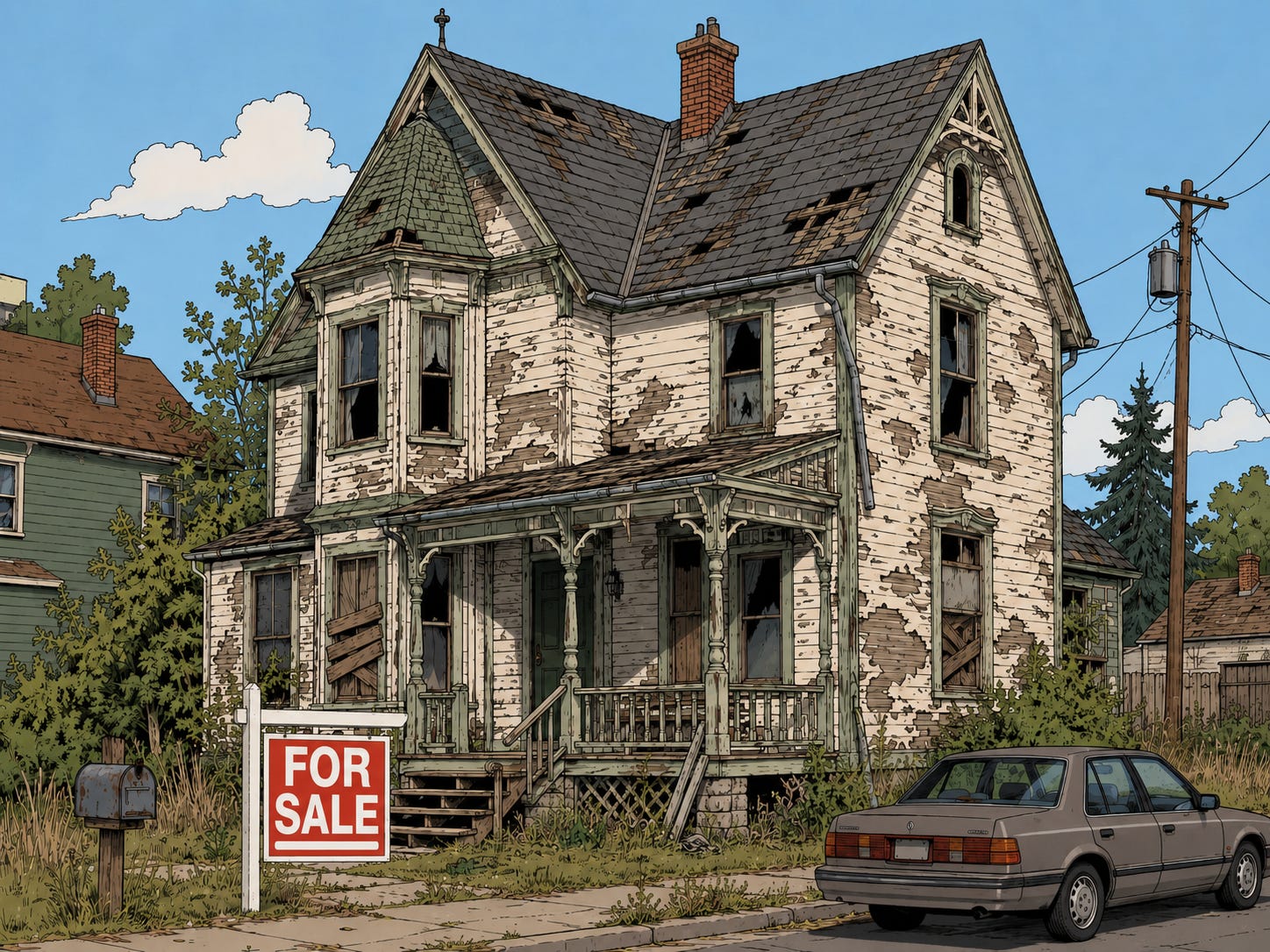
Figure 2. “Blue-chip heirloom asset in the heart of Buffalo, New York! Generous porch, original chimney, four bedrooms of timeless proportion - even a parlor. Antique furnishings and original fixtures convey. The mature, fully established grounds have reached a state of effortless self-sufficiency requiring no upkeep at all. A once-in-a-century opportunity for the discerning buyer who understands that they simply do not build them like this anymore. Offered at a price reflecting more than a hundred years of devoted family stewardship and the certain knowledge that home prices only go up over time.”
Why did this matter? Because “spending on housing is consumption, not investment” - it is unusual consumption, because you may end up with a return (though few calculate real returns factoring in costs and inflation), but it is nevertheless consumption: a place to sleep and relax between making your livelihood.3 And broadly, “When you shift capital (money) from production to consumption, you reduce your future standard of living” - the difference between buying things on Amazon versus buying Amazon stock. The problem compounds “when many (or most) individuals started viewing homes as investments, instead of as consumption, and also believed that these investments would continue to appreciate indefinitely in the future, they adjusted down their savings because they thought that ‘investing’ in a house was a form of saving.”
Home-buyers and lenders and the broader capitalist system reacted largely rationally to the rules set and enforced by the government, which hardly oversaw a free market - banking was (and remains) one of the most regulated industries in the United States and “there have been more subsidies for housing than for any other economic activity.” The men who lied on loan applications and the firms that knowingly packaged garbage were morally responsible for it - no theory of incentives launders a swindle into innocence. But it was policy that turned a thousand private vices into a single public catastrophe: it took the ordinary, ever-present supply of human greed and folly and aimed all of it, at once, at the same overpriced asset.
What facilitated the housing boom - some would say bubble, with prices running well past what expected returns could justify - and what turned that into a financial crisis and the Great Recession was, according to Allison’s telling, “primarily” the Federal Reserve’s mismanagement of the dollar and the enormous subsidies to housing funneled through Freddie Mac and Fannie Mae, the loan guarantors the government created.4 As the Austrian economists Peter Boettke and Steven Horwitz note, “The Fed’s low interest rates, combined with Fannie and Freddie’s government-sponsored purchases of mortgages, made it highly and artificially profitable to lend to anyone and everyone.” Secondarily, in Allison’s view: capital rules let banks hold mortgages - especially AAA-rated mortgage securities - while setting aside almost no capital against them, quietly herding bank balance sheets into exactly those assets. Those securities were rated by an oligopoly of agencies the government curated and incentivized to be less cautious in their standards. And the government dulled the market’s own defenses by guaranteeing most deposits (so customers stopped asking whether their bank was sound) and by bailing out failed institutions in earlier crises (so bankers stopped fearing what failure would cost them).
This series will go through those causes bit by bit.
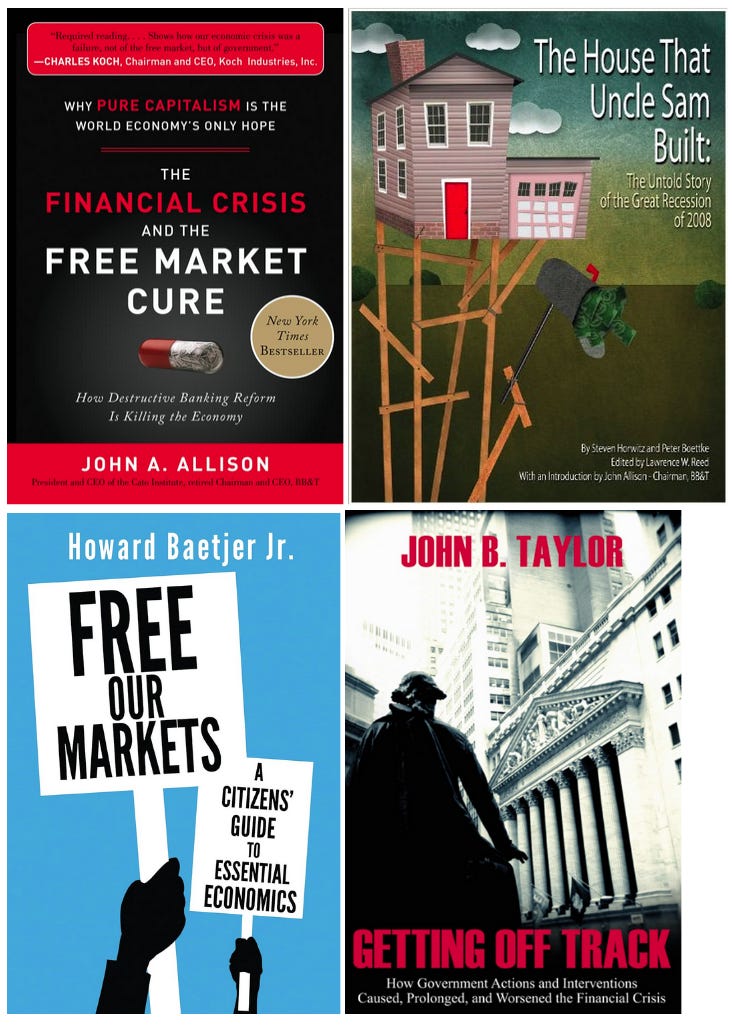
Figure 3. If you read only one book about the 2008 financial crisis, I recommend John Allison’s the Financial Crisis and the Free Market Cure: he plainly and vividly spells out why we got there from the perspective of a banker who managed to weather the storm. The book is not as great when it comes to saying what the response should have been, but we’ll revisit that. A 30 page condensed and understandable but sophisticated Austrian perspective can be read (for free) from Steven Horwitz and Peter Boettke: the House that Uncle Sam Built. Economics popularizer Howard Baetjer, Jr. wrote an excellent layman’s guide called Free Our Markets that also happens to have an extensive explanation of the crisis. The Stanford economist John B. Taylor wrote the relatively concise (105 pages) Getting Off Track but requires a pretty firm foundation of economics to understand - it’s not for golden retrievers. Along the way, I’ll be mentioning still more books.
Even to the degree that the return was 1% a year, as suggested by some, that pales in comparison to alternatives.
Bernstein: “Always remember, investment is the deferral of present consumption for future consumption and if anything qualifies as present consumption, it is a residence.” Obviously, in a previous era, property was much more closely tied to one’s livelihood.
George Selgin is a little cautious: “I have argued that an excessively loose Fed policy stance contributed to the subprime boom, and that an excessively tight stance contributed to the subsequent crash and recession. That’s ‘contributed to,’ not ‘caused.’ I am not blaming the Fed for the subprime crisis. I understand very well that that crisis was the result of many factors, some of which may have been more important than the Fed’s actions.” Lawrence White less so: “the Federal Reserve’s expansionary monetary policy supplied the means for unsustainable housing prices and unsustainable mortgage financing.” https://www.cato.org/blog/monetary-policy-primer-part-8-money-latest-great-muddle; https://www.cato.org/sites/cato.org/files/serials/files/cato-journal/2009/1/cj29n1-9.pdf