
Money, mispriced

The Gist: How the Federal Reserve drove the 2008 financial crisis.
Part of a series on the 2008 financial crisis. Find part one here.
Broadly, conservatives oppose the government dictating the price of goods and services, but don’t quite realize that the government substantially1 dictates the price of money itself - what a dollar is worth, and what it costs to borrow one. This is both the biggest cause of the financial crisis and the most complex; if it gets too tangled for a golden retriever explanation, you can always wait for the next email about housing subsidies (while conceding that central banking matters).
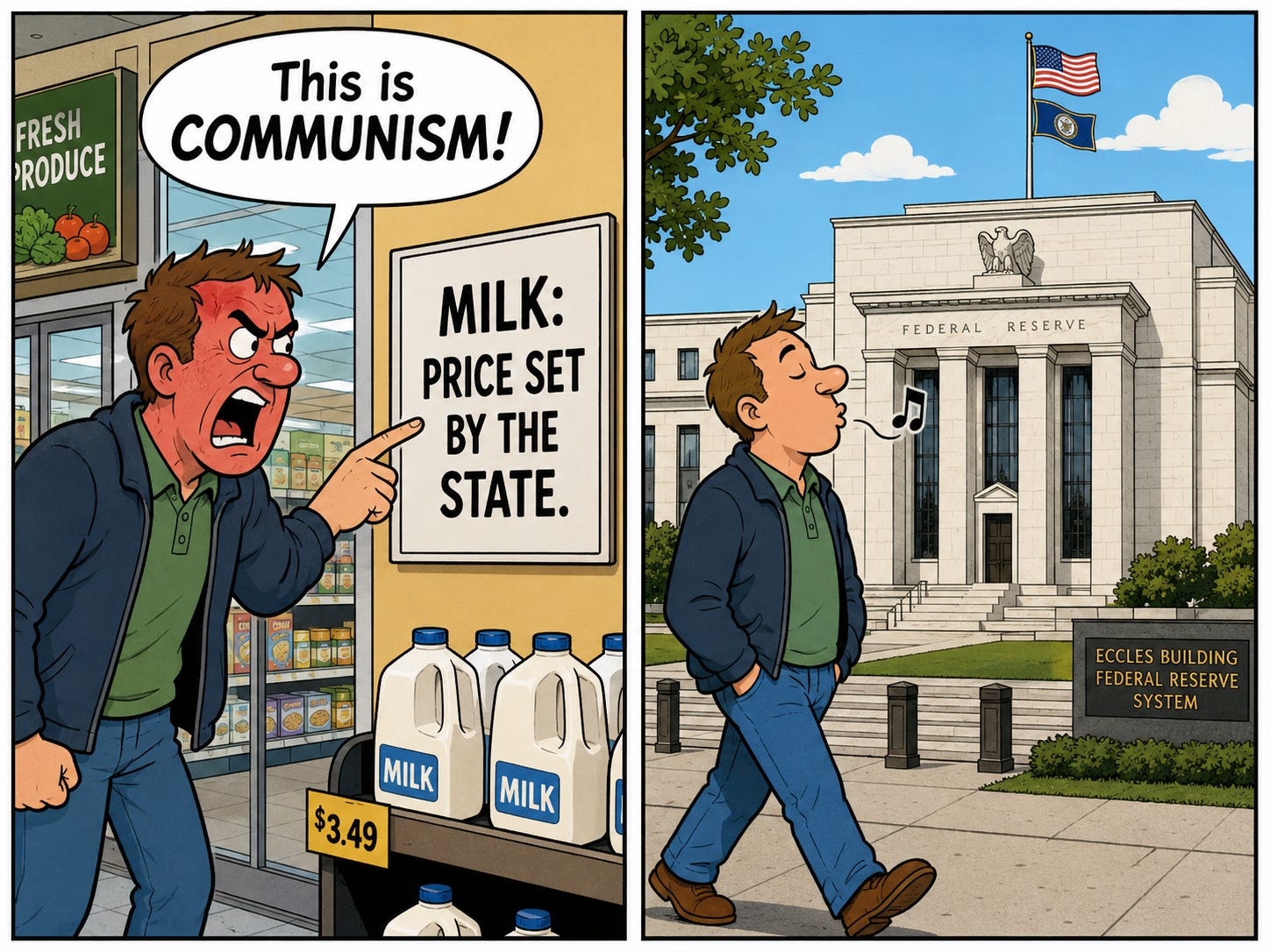
Figure 1. One is the most important price in the economy.
Absent war, the Federal Reserve did an okay job from its beginnings in 1913 until 1971 keeping inflation low - famously, for 73 years, from 1886 to 1959, you could buy 6.5 ounces of Coca-Cola for a nickel. The credit goes to the fact that the dollar’s value was anchored to gold, redeemable by American citizens and institutions until 1933 and by foreign central banks until 1971. But the anchor was no guarantee of competence: in the Great Depression, the Fed sat on ample, even growing, gold reserves and still refused to supply the liquidity that Milton Friedman argues could have prevented then eased the collapse. Once the gold tie was cut in 1971, the dollar bled value through the 1970s until Paul Volcker painfully broke the back of inflation, tightening policy while unemployment climbed and the economy slowed. In 1987, Alan Greenspan took the reins and would be heralded as the maestro of the Great Moderation - a long stretch of tame inflation, falling interest rates, and steady economic growth.
John Allison was a banker throughout, and he describes the problem:
“From the early 1990s until 2007, the U.S. economy experienced only a minor economic correction. One of the main reasons was that every time there was a problem in the economy, the Fed would act aggressively to eliminate the downside. This encouraged all of us in business to believe that the Fed had the ability to eliminate downside risk. In the stock market, this psychology became known as the Greenspan ‘put.’... The ‘success’ of the Fed’s efforts to prevent significant market corrections from the early 1990s to 2007, which was achieved at the expense of a massive misallocation of capital (especially to the housing market), laid the groundwork for the Great Recession.”
Over almost two decades, the put bred a generation of traders and bankers who had never worked through - or could no longer remember - a Fed that would let pain run its course. Greenspan seemed both able and willing to move the price of money in response to any difficulty. The Greenspan put looked like free flood insurance: why not build in the flood plain?
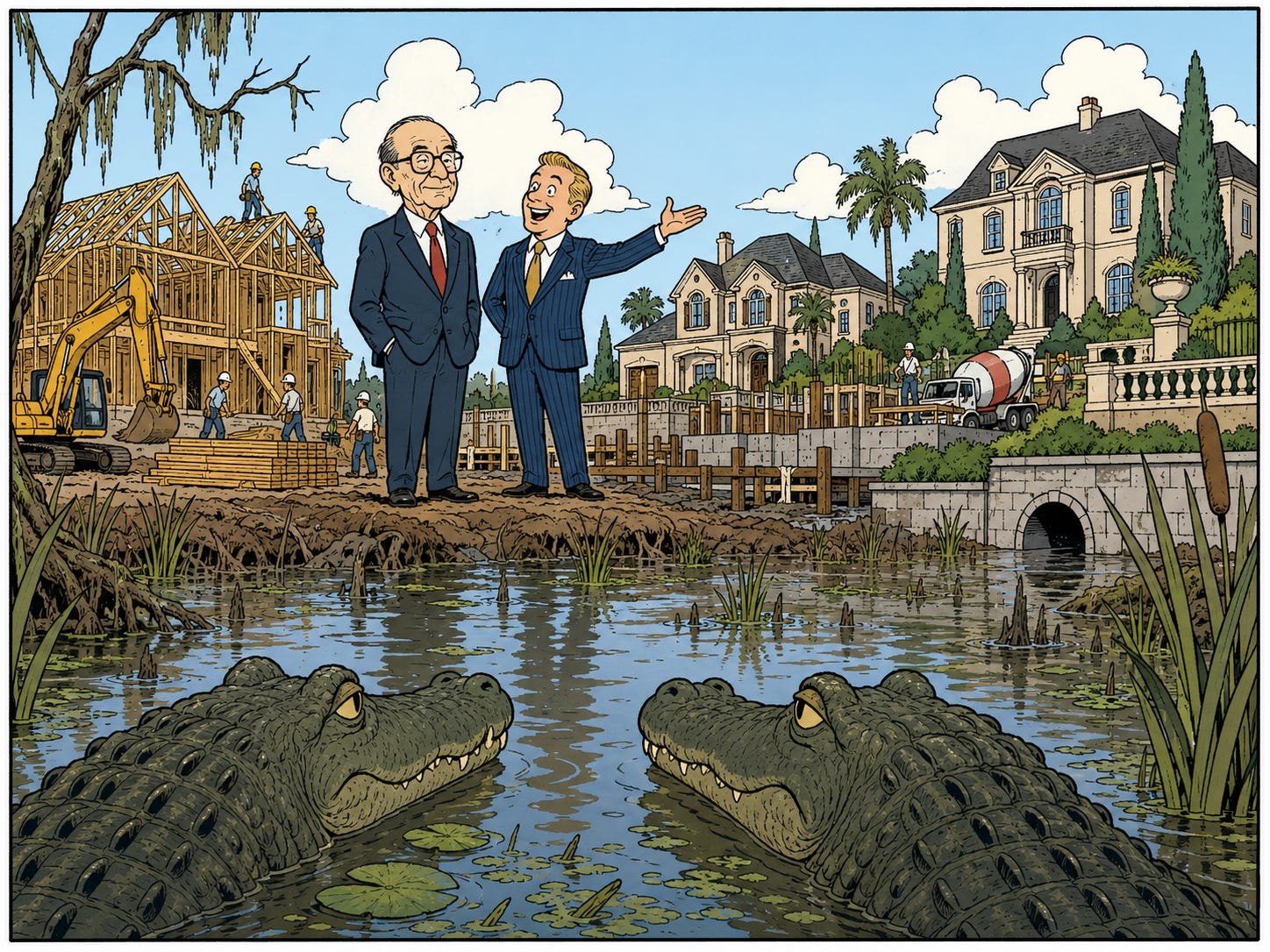
Figure 2. See you later, mis-allocator!
Beyond that reflexive rescue instinct, the Austrian economists Boettke and Horwitz observe,
“From 2001 to about 2006, the Federal Reserve pursued the most expansionary monetary policy since at least the 1970s, pushing interest rates far below their natural rate. In January of 2001 the federal funds rate, the major interest rate that the Fed targets, stood at 6.5%. Just 23 months later, after 12 successive cuts, the rate stood at a mere 1.25% – more than 80% below its previous level. It stayed below 2% for two years then the Fed finally began raising rates in June of 2004. The rate was so low during this period that the real Federal Funds rate – the nominal rate minus the rate of inflation – was negative for two and a half years. This meant that, in effect, banks were being paid to borrow money!”
Perhaps the most prominent contemporaneous critic was the Stanford economist John B. Taylor, famous (in the sense of the Wall Street Journal rather than People magazine) for having come up with “the Taylor rule,” which attempts to satisfy Congress’ mandate that the Fed simultaneously pursue stable purchasing power and maximum employment. Taylor worked for multiple Republican Presidents, including as a senior Treasury official during the first term of George W. Bush, and supplied key building blocks of New Keynesian economics while arguing for conservative, predictable, rules-based monetary policy. In 2007, at the Fed’s own Jackson Hole retreat, Taylor was explicitly, publicly telling central bankers that the federal funds rate - the rate at which banks charge each other for overnight loans, which the Fed targets - was held two to three percentage points below the prescription of his eponymous rule for years. “This deviation of monetary policy from the Taylor rule was unusually large; no greater or more persistent deviation of actual Fed policy had been seen since the turbulent days of the 1970s.” Taylor projected that, had his rule been applied, millions fewer housing starts would have occurred from 2003 to 2006. Taylor’s mantra is that the government - primarily the Fed - “caused, prolonged, and worsened the crisis.”
But if money was so easy, where was the inflation?
Allison argues it was plainly right in front of everyone’s eyes: house prices. The Fed did not correct, partially because its preferred methods of tracking inflation “measure[d] cost of living changes based not on house prices (even though two out of three people live in houses), but on apartment rental rates.” More specifically, the government attempts to calculate what owner-occupiers would have paid in rent for their living in their homes, an obviously fuzzy statistic, rather than the price of housing. The Yale (center-left) economist Robert Shiller’s index estimated that nominal U.S. house prices roughly doubled between 2000 and 2006 - and climbed well over half even after applying the standard inflation measure, and remember the comparison: “real house prices in the United States did not rise at all between 1890 and 1990.” But even if you were only tracking the most prominent inflation measure - the Consumer Price Index, John Taylor notes that the CPI “averaged 3.2 percent annually during the past five years, well above the 2 percent target.”
And yet, why should we expect (or plan) annual 2% inflation?2 George Selgin argues that, in a productive economy, entrepreneurs find ways to deliver better products more cheaply. Your (unregulated) phone has more compute than the computers that put a man on the Moon, and is considerably cheaper. Allison notes that in the 2000s, the technological innovations of the internet and the Chinese and Indian economies providing cheap labor should have meant that the dollar was able to buy more goods and services, not less. In other words, prices should have been deflating, not inflating every year. The anchor matters, and less than zero is the right one in a growing economy with a natural rate of interest discovered by the market and uncurated by the government. Instead of the dollar losing 3.2% of its value every year, perhaps it should have been gaining 1-2%, meaning inflation as we understand it was running uncomfortably high.

Figure 3. “Eight hundred fifty dollars two years ago. Six hundred now… My God… they’re becoming more affordable every year? Somebody must do something. Maybe we can get the union to protest? Every innovation is a dagger at the heart of aggregate demand! If everything is cheaper next year, people might save their money! It’s a rolling disaster!”
Not all economists - even those on the right, even those on the right skeptical of central banks - take the view that the Fed was being too easy. Scott Sumner, who has held fellowships at different libertarian think tanks3, rejects the “bubble” framing, thinks markets are efficient and provocatively notes that if 2006 featured a housing bubble, so would later years once the national index of housing’s real prices surpassed the 2006 peak (and one might reply by saying perhaps the bubble did in fact return! Or that 2006 remains the peak for the most bubbly areas). Sumner thinks the Fed managed the dollar well given the contemporaneous growth of the economy and relatively small official inflation - but that the Fed nevertheless was the cause of the recession by letting nominal spending collapse in 2008 - more on this in another email. End-the-Fed-ers Jeffrey Rogers Hummel and David Henderson argue that
“The market ultimately determines interest rates. Although central banks are big enough players in the loan market (and the quintessential noise traders to boot) that they can push short-term rates up or down somewhat, that ability is increasingly diminished, even for a major central bank like the Fed, as globalization integrates world financial markets. In defending his actions, Greenspan is correct in attributing the unusually low interest rates early this decade mainly to a massive flow of savings from emerging Asian economies and elsewhere.”4
In 2005 and since, Bernanke also insisted that the source of the low interest rates was the global savings “glut” - people around the world getting richer and saving money, which meant more money was available to lend out, and there was particular interest in the safe haven of the United States. Of course, with central planners at a central bank, we don’t really know what the natural rate is! But John Taylor insists, “Some argue… that there was an excess of world saving—a global saving glut—that pushed interest rates down in the United States and other countries. The main problem with this explanation is that there is no actual evidence of a global saving glut… the global saving rate—world saving as a fraction of world GDP—was low in the 2002–4 period, especially when compared with the 1970s and 1980s.”
Allison has his own take of interest to America First proponents:
“The Chinese government made problems worse. For political reasons, it was interested primarily in unemployment in China. Therefore, the Chinese government was providing incentives for producing goods to be used in trade and trying to hamper domestic consumption. One way it did this was by becoming a major investor in U.S. government debt, holding down interest rates in the United States. If the Fed had allowed the U.S. economy to adjust by having prices fall, the Chinese would not have been able to export to the United States profitably. They would have been forced to readjust more toward domestic consumption, which would have been healthy for U.S. exporters. By not allowing the U.S. economy to react as it would have done if it had had sound money, Greenspan was effectively encouraging the Chinese to expand their manufacturing capacity, driving manufacturing jobs out of the United States and into China.”
Regardless of the exact reason for the low interest rates, the effect on banks was the same. Allison reports that bankers, seeking profit and reading the Fed’s signals to mean that inflation would stay low indefinitely, “extended their bond portfolios” - grabbing for yield by lending for longer. Then Bernanke took over, continued Greenspan’s rate hikes, and the yield curve inverted (”short-term rates are higher than long-term rates”) - a disaster for banks, which borrow short and lend long and live off the spread between them. Allison complains, “Go back to 18 months before the Fed started its dramatic increase in interest rates and read its comments. There was absolutely no evidence that would have led bankers to anticipate a 425 percent increase in interest rates in two years.” Amidst the raising rates,
“Two important trends were magnified by the inverted yield curve. First, banks had to lend to clients that did not have access to the capital markets [i.e. couldn’t sell bonds], were willing to pay variable interest rates, and needed to borrow money. The residential construction and development sector clearly met these criteria. Second, one way to get higher returns is to take more risk. Faced with negative margins, many financial institutions started taking more risk because taking risk was the only way in which they could sustain their profitability.”
That margin squeeze was one channel among several - across the financial system, the broader hunt for yield was pulling money toward higher-risk, highly-rated paper like mortgage-backed securities - but it steered banks straight into the riskiest corner of the housing boom.
One final note: a monetary explanation is also the one that best explains why the crisis was global (beyond the fact that people all over the world were invested in the US and its bonds). John Taylor’s data show the United States was not the only central bank holding rates far below what its own conditions warranted - only the largest - and that the housing booms were biggest where the rule-deviations were biggest. Why did the looseness spread? Because, as Taylor argued, central banks were following each other: no central bank likes to watch its currency soar while the Fed eases, so to protect their exporters they kept rates low too. Further, the European Central Bank’s one-size-fits-all rate was a straitjacket for Germany and a tank of gasoline for Spain and Ireland, which is precisely why those two deviated most from a sound-money rule and boomed hardest - and the common collateral was government-blessed: the international Basel capital rules made AAA-rated mortgage paper nearly free to hold everywhere, herding banks on both continents into the identical assets.
We will soon revisit what happens once the crisis takes hold - when money market interest rates spike in August 2007 and beyond - but the most important takeaway is this: The Federal Reserve sees itself as the economy’s fireman but it also, alas, its arsonist - the maestro was in fact playing with matches. Rather than reforms that would let the market discover the natural interest rate and get clean signals from the value of money, the Fed has accumulated more power - in 2008 and again amid COVID - and a far bigger balance sheet to sway what happens for you and your family.
The government cannot just say “money is worth X” - markets react to government policies that aim to control it. More precisely, the Fed directly controls only the supply of base money and the overnight rate banks charge each other, which it targets. From there it heavily influences - but does not set - longer-term and "real" (inflation-adjusted) rates, which also answer to savers, borrowers, productivity, and the flow of global capital. What it can do is shove the market rate below the "natural" rate the economy would otherwise discover; what it cannot do is repeal that natural rate. The gap between the two invites malinvestment and an unsustainable boom. Over the long run the Fed does largely determine the dollar's trend value, because it controls the money supply; it simply cannot durably override the market price of real borrowing without paying for it in inflation or malinvestment. "Dictates," then, is shorthand: the Fed is less a dictator than a very large thumb on a scale the market is always pushing back against.
The reason offered by central banks is (1) that it’s a cushion that allows them to cut rates in a downturn; (2) that it is mild enough not to be dangerous while fooling people into thinking they always have a little more money, which spurs consumption and, in their minds, growth; (3) a little inflation helps employment negotiations because the boss can not give you a nominal raise while paying less real money - if deflation is happening, an employee may be frustrated that he is making the same when he is in fact enjoying more purchasing power. But central banks are also especially alarmed about bad deflation that occurs in a crisis, and a subject we’ll address in a future email. Selgin notes that their fears confuse bad and good deflation.
Mercatus and the Independent Institute. Sumner’s book on his approach (“market monetarism”) and the financial crisis is The Money Illusion. Sumner believes that “We’d be better off with absolutely no regulations of the banking system (other than laws against fraud)” and that there should be no bailouts but he is critical of libertarian monetary policy: https://www.themoneyillusion.com/wp-content/uploads/2023/03/Sumner_AlternateApproachesMonetaryPolicy_v1a.pdf
https://www.cato.org/sites/cato.org/files/pubs/pdf/bp109.pdf. And I should note that even Greenspan was Ayn Rand’s personal economist and a gold standard fan, having written a defense (never repudiated) in Capitalism: the Unknown Ideal.