
Hacking education

The Gist of Cyberschooling: Curated technology can do things unimaginable and impossible to previous generations of education thinkers
Part of my How Homeschool? Series and the second installment of Cyberschooling. Find part one and part three here.
Even acknowledging their problems, LLMs can be pushed in the direction of approaching the Young Lady’s Illustrated Primer that used to live only in science fiction. Take a subject that I know well: United States history. I am very confident that an LLM, properly prompted, could massively help a dedicated student get a 5 on the associated AP test and be a better way to learn than most methods even the best students have used in the past. You can start simply by asking the most sophisticated LLM you can afford: “I am determined to get a 5 on the AP US History exam and you are going to help me do that - outline the content that the AP exam prioritizes, era by era, and then draft for me flashcards to input into Anki so I can memorize the information effectively.” Working that alone could probably hack the test, but if you wanted to actually learn American history, the LLM could recommend great books to give you a coherent overall narrative or dig deeper into a special area of interest. Next, ask the model to generate questions in the style of the AP exam (you might need to upload a sample), then answer them, then ask for feedback on how to improve your answers, and then answer again. Take official practice exams and track progress - and keep asking the LLM to be brutally honest about what you need to do to get a perfect 5. None of this runs itself. Most students won’t do real daily study without adult oversight. That adult will either have to sit down with the student for the whole learning experience (and edit prompts as necessary), or be the prompter and then present the LLM’s output to the child to work on, or review the transcripts of the child interacting with the LLM (which can easily get very long if there’s a constant hours-long conversation - do you need an LLM to review it all and summarize? Can you avoid the child deleting transcripts?).
A reasonable objection might be that this approach gets students those facts of American history of interest to the College Board but fails to convey the meaning of American history. But, amazingly, you can also direct an LLM to give you an interpretation of American history according to whoever you’d be most sympathetic to, and even ask that interpretation to be contrasted against others. “How would Milton Friedman view the events covered in this? Karl Marx?”
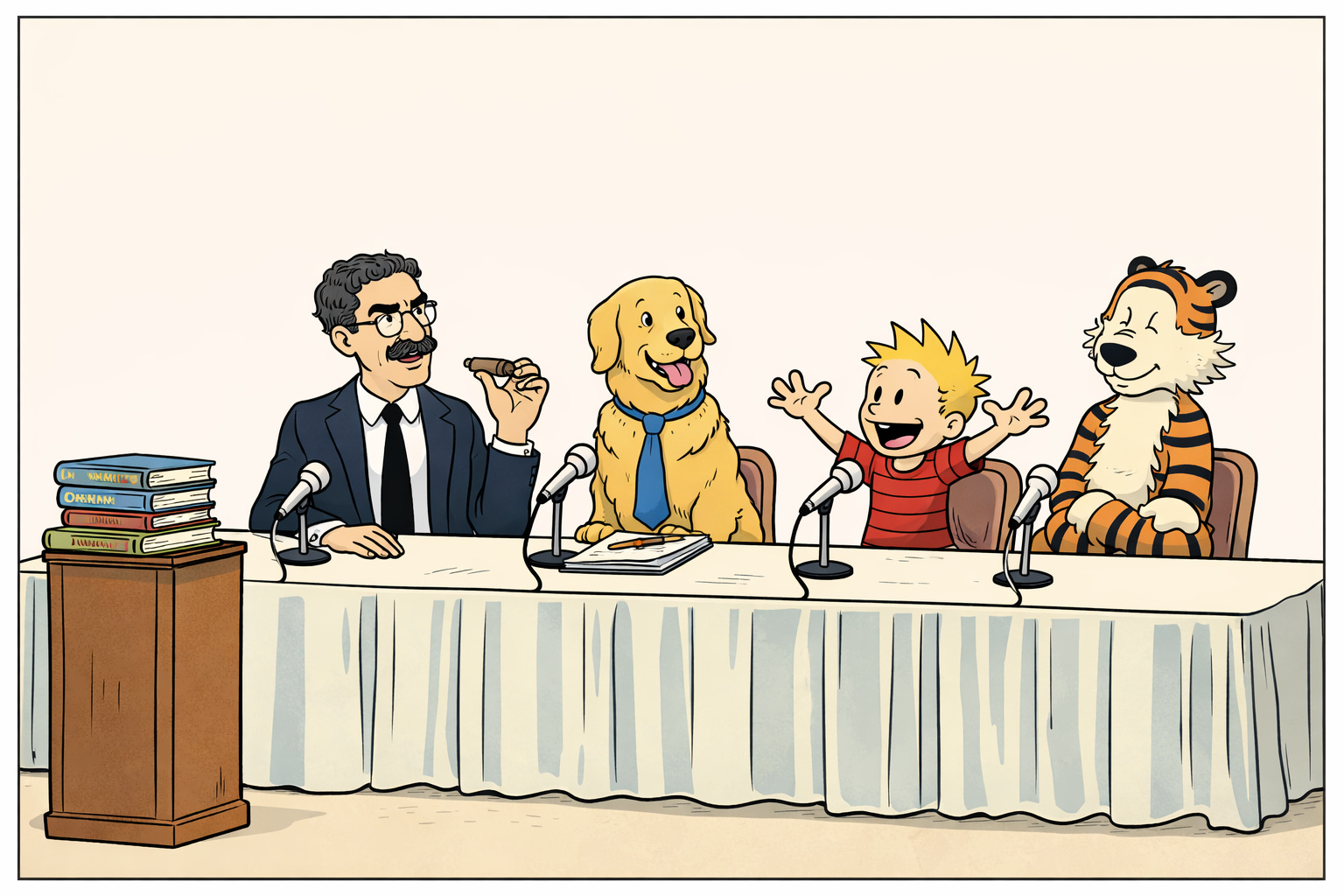
Figure 1. “The Marx Brothers? A golden retriever? Calvin and Hobbes?”
But wait - what’s this Anki thing that I smuggled into the previous prompt without any explanation? One of the best parts about cyberschooling, Anki is a free flashcard program that leans into the best cognitive science (spaced repetition) about how to ensure you remember something you want to. While flashcards have existed for a long time, Anki makes their management dramatically better. You (or an LLM) can write the cards - or you can use shared decks - but the magic is the algorithm: when you recall a card easily, Anki pushes its next appearance further into the future; when you miss, it brings it back sooner (and you can tune how aggressive this is). Over time, well-learned cards appear only every few months, so daily review stays manageable even as total cards grow. It’s widely used in medical education because it turns “I should remember this” into a daily, measurable habit. Anki can be used to memorize almost anything - E.D. Hirsch facts, Scripture, foreign-language vocabulary, etc. But it’s probably best used to read the context first, then use Anki to lock in the things that tests (and perhaps life) will demand on command.
Till this moment, I have focused on using LLMs for the humanities, but math is much more teachable, much less likely to be ideologically loaded, and you can measure progress with ruthless clarity. I am generally skeptical of bespoke programs, especially those that attempt to gamify, because they are so geared toward mass appeal rather than delivering results. Most “brain games” apps are useless at best. Duolingo is a very popular gamey foreign language learning app that has pretty thin independent studies showing its users actually become conversationally fluent. I am not sure how to evaluate Synthesis - which is spun off a school Elon Musk founded for his kids (but no longer uses) - that gamifies “conundrums” for teams of children to wrestle with.
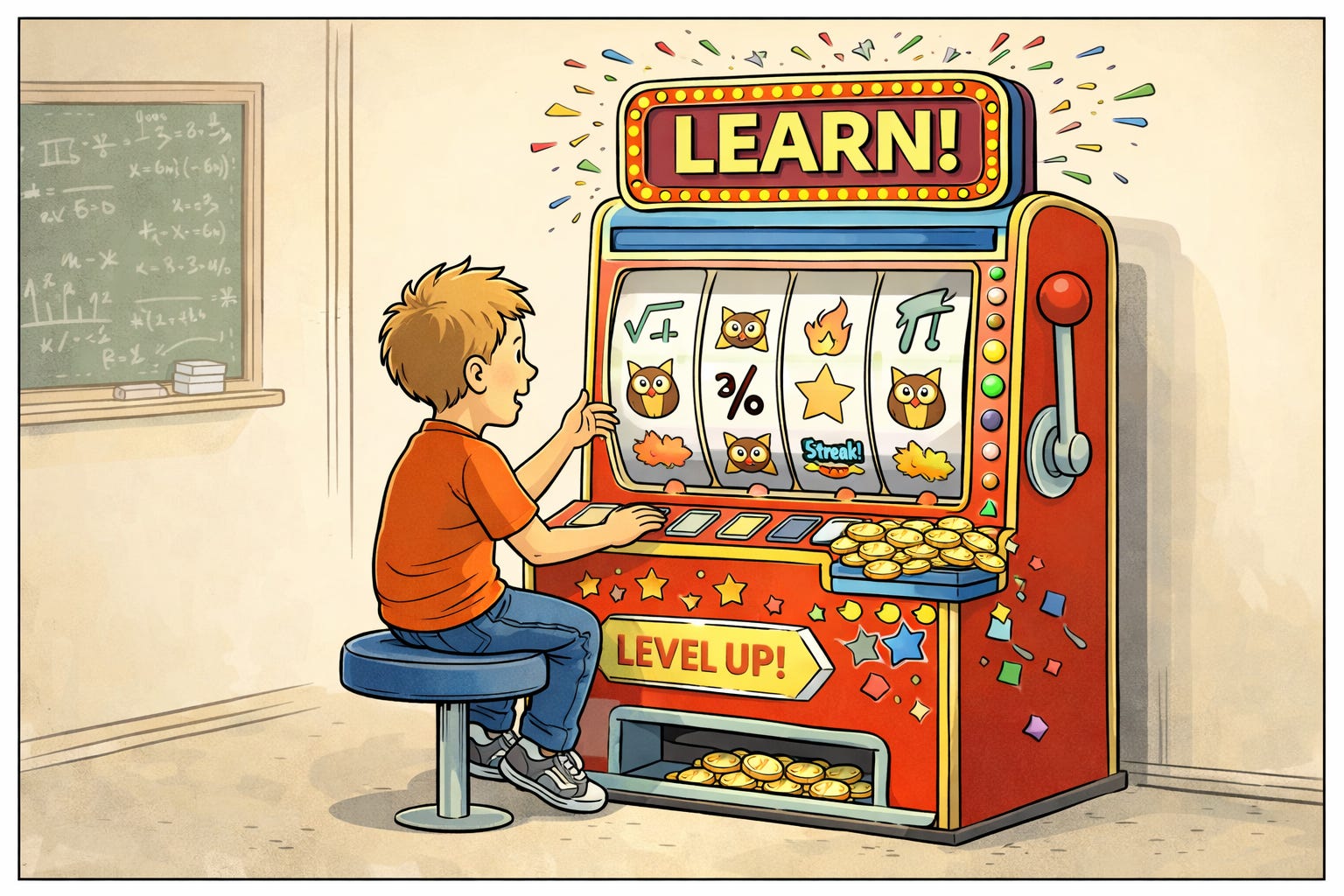
Figure 2. Personalized, adaptive, gamified, optimized for engagement, meeting the learner where they are!
But I am very impressed with Math Academy, which began as a program for 5th graders in Pasadena public schools that scored in the top 10% of a math placement exam; they were put through an individualized adaptive courses and wound up scoring 5s on BC Calculus three years later (it’s typically taken by high school seniors; in fact, based on public reports, Math Academy appears to account for a significant portion of all 5s in BC Calculus by 8th graders). Math Academy models their program on a student working 40 minutes “of focused effort” per weekday and, like a more sophisticated version of Anki, continuously adapts its math problems to ensure its students are retaining their basic core of knowledge while expanding into new realms. As a result, Math Academy claims “students can learn math multiple times as efficiently as in a traditional classroom, students who continue working at a normal ‘school workload’ pace of an hour or more per weekday throughout the year will learn multiple years of math in one year – in a fully comprehensive curriculum, without skipping any content.” Importantly, unlike practically anyone else trying to sell a super-app for learning, Math Academy insists that learning is actually hard: “Deliberate practice requires effort and is not inherently enjoyable. Individuals are motivated to practice because practice improves performance. In other words, maximal learning does not happen naturally as a result of maximizing other things like enjoyment, comfort, convenience, and ease of practice. In fact, maximal learning is at odds with some of these things. Sacrifices must be made.” They are realistic that “all can learn some, many can learn more, but few can learn all” - all meaning partial differential equations, algebraic topology, Ricci Flow with Surgery - but also insist “struggle does not imply inability.”
The magic of Math Academy is that it is focused, personalized, and interactive - and their manifesto is admirably dedicated to the most proven educational research. Still, even Math Academy’s “Chief Quant” Justin Skycak learned in high school from watching MIT’s courses online.1 MIT truly is remarkable for being so aggressive about opening up their coursework; actual MIT students pay over $60,000 a year to take this in person. But one should bear in mind three things. First, the courses are pitched for the extremely intelligent: 75% of MIT students scored in the 98th percentile or higher on the SAT. The courses may be poor introductions for your student. Second, somewhat ironically, just about the time that MIT decided to put all their content online, they realized that at MIT itself, the lecture system was broken and that they needed something more interactive. As Skycak relates,
“The problem, according to John Belcher, the MIT professor who spearheaded the effort, was that a staggering number of undergraduates were failing their freshman (first-year) physics course, a general education requirement…: ‘Teaching freshman courses in a large lecture hall with over 300 students … is based on the assumption that the instructor can ‘pour out’ knowledge from his or her vast reservoir into the empty glasses of the students’ minds. If this were true, students at MIT would not fail these large required classes. The high failure rates in these courses at MIT, approaching 15%, and the low attendance in lectures at the end of the term, less than 50%, suggest that there is a basic flaw in this model of instruction.’”
Whether it’s an MIT lecture, or Shakespeare, or anything that is passively consumed but desirably learned, you would be extremely well-suited to press LLMs into service to interrogate your understanding in a Socratic way, to push back, to answer your questions. In fact, the biggest problem LLMs face is this: do you have to be really smart and skeptical to make them work - and isn’t that very intelligence and skepticism what makes you work anyway? You really have to harangue the LLMs to make sure you’re actively learning, and toward mastery because LLMs don’t make you serious, though they can reward seriousness.
Third, while it is a gift to have Walter Lewin making physics come alive and a class on how to make (almost) anything, it is also unbelievable that one of the leading scientific universities in the world also teaches Black Feminist Health Science Studies with “scientific truth” in scare quotes. Sadly, I would personally be cautious about taking any humanities classes at MIT.2 Instead, you have to hunt for the smartest, aligned takes - and LLMs can probably help you, but we’re talking about items like Yale’s Donald Kagan on Greek history and serious lectures and interviews from the likes of Antonin Scalia, Friedrich Hayek, Thomas Sowell, RC Sproul, Richard Pipes, etc. We have Michael Faraday’s Christmas day lectures in print and the classic video of “The Art of Doing Science and Engineering” from Richard Hamming, a Bell Labs scientist renowned for simply explaining technical concepts. In addition, the right human curators can point you to amazing resources, e.g. Charles Murray noting how you can become statistically literate.
The enemy is edu-tainment: shallow content that flatters (and fools) you into thinking you’re learning when you’re not. Even as you take advantage of the internet, you do better to treat it adversarially, assuming that it’s trying to get your eyeballs for ad revenue streams rather than genuinely teach you. The more views something has, the more attractive the presenter, the shorter the presentation, the higher the production value, the more cuts to different scenes, the more fun it is, the more emotional it is, the less references to books, the more likely it is to be edu-tainment. Obviously, one can do far worse than binging on PragerU explainers or watching a documentary a day, and there are multi-hour online Hillsdale presentations, even a whole Ron Paul homeschool curriculum, but TedTalks, MasterClass, the History Channel, your favorite podcast are all geared fundamentally toward entertainment. In the cyberschool theme, one can imagine the value of “really being there” through virtual reality but its education value must be closely scrutinized - immersion is not necessarily understanding; the far better proven model is Khan Academy, a nonprofit that offers free courses intended to teach.
And yet one form of edu-tainment, while never being good on its own, can lead to insights: historical strategy video games. You won’t learn much from a chaotic first-person shooter loop of dying and respawning in digital Valhalla. But the better grand-strategy games (Paradox’s medieval, early-modern, and WWII sandboxes) can give players a sense of geography, constraints, logistics, and incentives. This can make a fact like “the Suez Canal matters” feel real when winning is on the line. Such games can also accelerate an interest in history, leading down crazy rabbit holes of research. Most video games will not educate but Microsoft Flight Simulator can build navigation and cockpit familiarity; Kerbal Space Program can make orbital mechanics intuitive; and Papers, Please can teach the banality of an evil bureaucracy. If all this is a bridge too far, well-designed board games can achieve similar results (e.g. Twilight Struggle, about the Cold War). Still, do note that most games attempt to give the player something to do, so politically themed ones can over-privilege central planning narratives at the expense of market forces.
Also: do not underestimate Wikipedia and Grokipedia as resources. Plenty of children of yesteryear grew up reading encyclopedias from A to Z. Online encyclopedias have their problems (uneven quality, bias), and a comprehensive read is both impossible and undesirable, but they can be very helpful introductions to any subject that does not require working problems (e.g. not math, chemistry, physics). With the help of an LLM, you could easily construct a reading list that would give you breadth of knowledge about modern society.
The internet isn’t just for consuming knowledge - it’s for producing value. There’s a famous New Yorker cartoon with the caption “On the Internet, nobody knows you’re a dog.” Also true: On the Internet, nobody knows you’re a kid. While that means some caution is merited to avoid your child being exploited, that also invites opportunities for your child to run a genuine business: can they be doing Upwork? Selling things on Facebook marketplace? Building an app?
What might a typical day for a cyberschooler look like? Wake up and dedicate 40 minutes of focused effort on Math Academy. Spend 50 minutes reviewing Anki cards you’ve built with LLM help for your AP subjects. Then spend an hour on LLM-generated practice questions - answer, get graded, reanswer, repeat until you’ve mastered the material. In the afternoon, watch a lecture from a leading expert and take notes; upload the transcript (and your notes) to an LLM and let it quiz you on your understanding. Follow that with a half-hour Zoom call in Mandarin with a tutor in China. Conclude with five encyclopedia articles on tomorrow’s topics (or an hour working your online business). When your work is done, unwind with Europa Universalis.
Of all the essays I’ve written, this one risks becoming the fastest out of date. But that also raises the question: for all the others, are they really timeless comments on the best way to teach children, or are they already out of date themselves? “Cyberschooling” can mean a thousand things; I’m not pretending this is an apples-to-apples comparison with every other homeschool style. This is narrower: what if you deliberately build around technologies older theories never assumed - adaptive algorithms, LLM tutoring, and a near-infinite library? The core promise is not “screens.” It’s personalized sequencing, constant feedback, and optimized retention at a scale that until recently was basically impossible. Put it this way. In the mid-2000s, a great human tutor would usually beat “online learning.” In 2026, the best systems can do something different: they can individualize practice minute-by-minute, track performance continuously, and generate endless targeted reps - while humans supervise, motivate, and enforce accountability. Math Academy frames the constraint bluntly:
“Given a sufficient degree of accountability and incentives, there is no law of physics preventing a teacher from putting forth the work needed to deliver an optimal learning experience to a single student. However, in the absence of technology, it is impossible for a single human teacher to deliver an optimal learning experience to a classroom of many students with heterogeneous knowledge profiles, each of whom needs to work on different types of problems and receive immediate feedback on each of their attempts.”
I’ve attempted to write up what I thought “worked” but what if we took up cyberschooling 10 notches and really leaned into what a cyberpunk move-fast-and-break-things cutting edge Silicon Valley native would do? Hack the system, especially tests: what is the minimum effort required to ace everything and signal to employers (including college admissions if necessary) that this kid is worth paying? Much more STEM than typical school - that’s what actually advances society. Probability-first math. Computer languages > foreign languages. History of tech. Science fiction as literature to provoke the imagination. Write memos, not essays - and crafting social media posts well is more valuable than any other external writing. Fail fast with rapid feedback loops, then decompose skills, drill bottlenecks, and self-correct; reward performance with crypto. No grades, just binary: mastered, not yet mastered. Gamify when you can, but even better: have projects where kids can build and actually ship a product or make something to otherwise demonstrate competence, not a credential. Nothing can be justified by “this is how we’ve done it before”: What will the successful citizens of tomorrow need to know, and how can we best teach those things to our kids today? Constantly ask the LLMs: what would Musk do? What would Bezos do? What would Thiel do?

Figure 3. GPT’s impression of the stereotypical cyberschooler
And yet the case against cyberschooling is simple: paper cannot think for you. In the pre-internet era, a child’s question would best be answered with “I don’t know - let’s find out!” - and that sent you to the library, where the friction of finding the answer meant browsing adjacent shelves, skimming tangential entries, and building the scaffolding of general knowledge. Google reduced that friction: you still had to read through articles, evaluate sources, synthesize. An LLM eliminates it entirely. The precise answer arrives in seconds, with nothing learned along the way except the answer itself. I began writing these homeschooling essays without LLM assistance, which meant reading dozens of books. Would an LLM have been faster? Certainly. Would my understanding be shallower? I suspect so - and recent research suggests this isn’t mere intuition. In one study, “Cognitive activity scaled down in relation to external tool use… Over four months, LLM users consistently underperformed at neural, linguistic, and behavioral levels.” Most striking: participants without even search engines performed best of all. And yet… I certainly now benefit from interrogating LLMs based on what I know.
Do not give into screens just out of a sense that your child will be “left behind.” I will repeat for emphasis: Because, unlike basically every other approach I’ve discussed, cyberschooling can be so easily abused by students, overseers must be absolutely vigilant in ensuring children actually learn. There genuinely are amazing resources online and I do think they are worth taking advantage of, but screens are not unmitigated goods.
Thanks for reading! Tune in next week for the final installment of Cyberschooling.


Libertarianism in History features a sign that says “ObamaCare. Awesome”; my brief survey of history course syllabi did not endear me to their approach; etc. Notably, MIT also has a course on “Magic, Witchcraft, and the Spirit World,” which I can see going haywire.